In short
At Medida, demand for content grew faster than the team. So I built AI workflows that handle the repetitive part and leave the decisions with people. The result: 35% more content, with the same quality bar.
Every workflow runs in AirOps grids with its own prompts. Some run alone; others connect through Zapier, a CMS plugin or a direct API. Text, audio or video, a person checks the finished piece before it is published.
I built the framework myself, from AirOps grids to Zapier and API connections and CMS plugins where the system allows. I keep it free of bugs and up to date, and trained the whole team to run it on their own.
The problem
Most of what we were asked for was written content, and the requests kept coming faster than the team could grow. Hiring more people for repetitive steps wasn't sustainable, and lowering the quality wasn't an option.
The team
A multidisciplinary team, reorganised around the work. The content specialists, copywriters at heart, took on all the written content with the new workflows. The designers moved to a team of their own and started working with video generation tools.
The system
The workflow does the heavy lifting. People step in once the piece is finished and before it's published, to approve it or send it back.
 + CMS plugins and APIs
Video
Video is semi-automated. Flows in Magnific take on a big part of the production, and we're exploring full automation with Claude's MCP connections.
Result
content produced, with the same quality bar.
What I learned
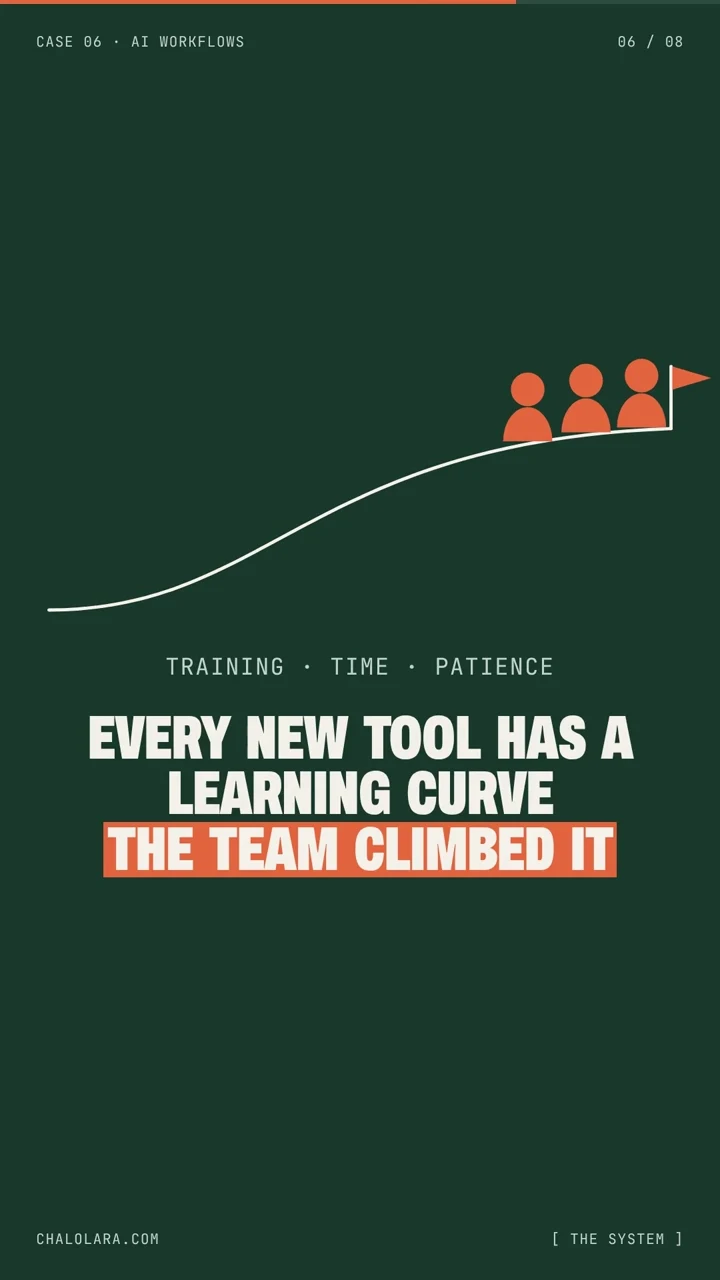
Setting up the framework is the easy half. The other half is the team understanding how the content is generated, so they can work with it without someone standing behind them.
That takes time and workshops, so budget for the training, not just the tools.
Video automation takes much longer than you think.
The content specialists and the design team at Medida.